Monday, November 22, 2010

Remarkable Denmark

Lonely with the boy gone and itching for a distraction, I took last Thursday and Friday off and spent a long weekend in Copenhagen, Denmark. This was my first venture into Scandanavia, and it didn't disappoint. The weather was chilly (I had to walk home in freezing rain after missing the last metro the first night, then saw my first snowfall of the year the next day) and dark (the sunset currently occurs around 4pm, and will apparently only get earlier as winter progresses). However, the city was charming and the cleanest that I've seen in Europe, and despite the climate, its people went out of their way to be friendly and welcoming (in perfect English, no less). They were, for the most part, predictably tall, blonde, and beautiful (although I couldn't take them entirely seriously given that listening to their native tongue reminded me of the Swedish Chef).

I'll stick with the Danish theme for the next few days, so stay tuned for more Copenhageries. I'll start off with a few general street shots from my wanderings to set the tone:

View towards the sea from atop the appropriately named "round tower":
Different view:
Saturday window shoppers on the street below:
Central plaza at nighttime:
The spire rising from hippie haven Christiania, and a few of Copenhagen's huge collection of bikes:
The old stock exchange (the twirls on the spire are actually the twisting tails of two dragons):
Noreport harbour and its rainbow row houses:

Thursday, November 18, 2010

Chocopocalypse

According to an article I read recently, we might be running out of chocolate. To quote one of my favorite bloggers: PANIC!

As a chocoholic, I find the threat of a chocopocalypse deeply distressing. I use chocolate as a stress-reliever, an anti-depressant, a motivator and a reward for productivity--essentially, for everything, always.

As a word nerd, I couldn't pass up the opportunity to write about this to give myself the excuse to make the lovely porte-manteau in the title. Sorry y'all.

Fortunately, unlike in the case of endangered honey and mysteriously vanishing bees, a chocopocalypse is still reversible. Basically, the cocoa plant is a pain in the ass to grow, and not profitable enough considering the effort, so farmers abandon it in favor of alternate cash crops. The result is that the current demand is overwhelming the supply, so unless something changes, we'll eat through our stores until there is nary a Worther Bud or a Nestle Bittersweet chip left to nosh on.

In conclusion, savor those Hersheys bars (except Hersheys is honestly pretty shit, so I'd go Godiva or at least Cadbury's if I were you, but to each her own indulgence). You never know, a few years from now our children could be asking us "you actually tried chocolate?!?" in the same way we incredulously ask our parents if they remember life without color tv. By that point, there will be a whole new level of the "fiction" of Charlie's Chocolate Factory and Chocolat beyond oompa loompas and impossibly debonair river gypsies. And I have to admit, the death by chocolate river drowning (à la Augustus Gloop) will not seem nearly so horrible in the face of a chocolate-less existence.

Wednesday, November 17, 2010

Promenade in the parc: adieu l'été

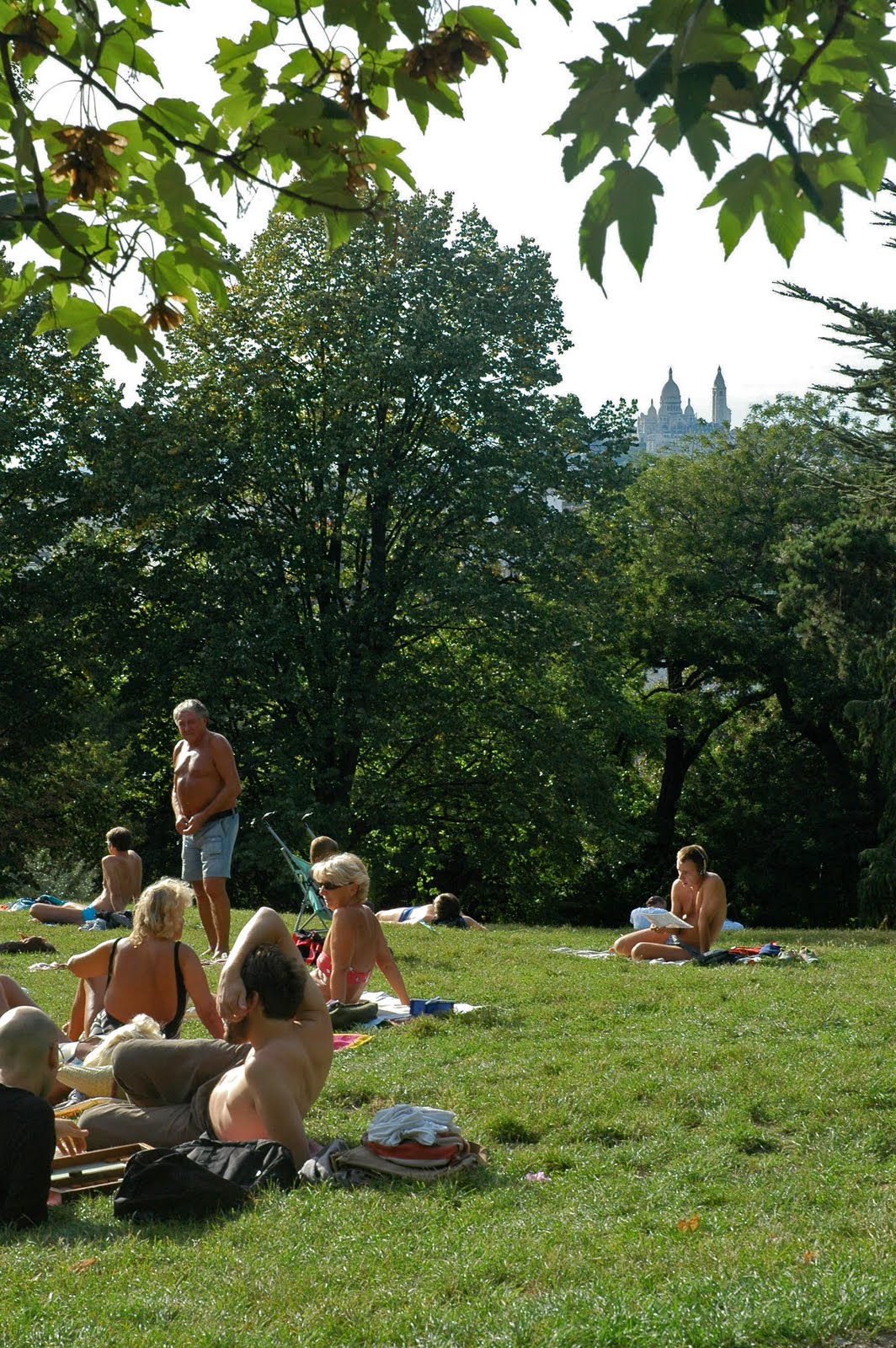
While looking through my photos I came across a set taken on a late summer Sunday in the middle of my blog shuffle, which were, as a result, never published. They're of Parc des Buttes Chaumont and, I'll admit, a little out of season, but looking at them from under a blanket while I struggle to return circulation to my toes on one of our coldest days yet has brought on such a strong wave of nostalgia that I figured I'd share.

The parc is far from the flat, manicured, fountain-filled Luxembourg gardens that Paris is famous for in both locale and style. Located in the 19th arrondissement, it embraces (and exaggerates) the hilly topography of the quartier and has a distinctly "wild" look--of overgrown forests, rope bridges and secret waterfalls that, while obviously carefully engineered, are nonetheless a nice escape from urban life.

Here's a shot of sunbathers and picnickers down one of the parc's many sunny slopes. I love the girl in the white dress sauntering purposefully past in the foreground:

And another. I didn't get a picture, but there was a jazz band performing at the pavillion on top of the hill, so everyone you see was being treated to a free concert.
You can just make out the spires of the Sacre Coeur in the background:
Waterfalls:
Downhill, the water from the falls slowed to a stream. Children splashed in the shallows in various degrees of nakedness, running behind trees to relieve themselves when the urge struck. Although the sight is a little surprising to Americans, I remember having similar experiences of seeing children (of all ages/genders) naked in public on the beaches of Nice. I really like how much more relaxed the French attitude towards the body is (at least as far as children are concerned):
I found a friend:
To be sung to the tune of "hole in the bottom of the sea": therrrrre's a pavilion on the cliff on the island in the lake in the valley of the center of the park!
The same, from a different angle (down by where all the gaufre and crêpe carts were...yummy!):
The Indiana Jones-esque bridge leading to the island:
The view of the shore from the bridge:
A cute gay couple kept posing for me as I snapped pictures of the pavilion. I don't know if there was some sort of gay holiday I wasn't aware of or if the queer community just congregates in Buttes Chaumont, but I have never seen so many same-sex couples outside of Pride parades and Indigo Girls concerts (don't judge! they're good!).
A better view of the distant Sacre Coeur, from the top of the island cliff:
The top of the island also afforded an excellent view of a rather odd installation art piece in the moat below, a sort of lily pad colony of red blood cells:
And finally, here's us, looking warm and happy and full of vitamin D. Aw.

Monday, November 15, 2010

Snapshots from the Norman countryside

After absorbing as much war history as possible in Normandy's museums, we spent the night in a sleepy seaside town. Though the town's boarded-up bars and proliferation of B&Bs attested to the beachgoers that would seep in as soon as the endless rainy fall/winter/spring season began to wane, while we were there it was all but deserted. The students were sullen about the lack of nightlife (all the better to chaperone you, dears!) but for me it was a nice escape from the city, and I took the opportunity to take a long, sunset walk down the shore and around the surrounding farmland. Here are a few glimpses of what I found:


Thursday, November 11, 2010

Remembrance

In honor of Armistice Day (or Veteran's Day, as we 'muricuns call it), I thought I'd take a brief intermission from my usual frivolous ramblings and share some photos and reflections from a recent trip to Normandy's World War II memorials and first landing beaches. If you prefer light-hearted material go ahead and skip this post and come back tomorrow when regular programming is scheduled to resume.

Although I've been to France several times, the Normandy war sites were never high on my list of things to see. Not only am I not much of a history buff, but the sites are spread out and difficult to access by train--my preferred method of getting around. However, when the study abroad company that I work for offered me transportation, food and accommodations to chaperone their student trip to Normandy I was only too happy to accept the offer.

The first stop on our tour was the Museum of Peace in Caen, which was a truly incredible museum. The choice to focus on "peace" instead of war or memorial really changed the experience, because rather than addressing the horrors of war (à la the traumatic D.C. Holocaust Museum) or the politics and ideology behind them, the museum posed the more philosophical questions of the definition, the obstruction and the price of peace. The result was a very global, unbiased view of conflict, where the narrative was no longer about "good guys" and "bad guys," but about universal human suffering and attempts to overcome it.

The architecture of the museum expresses its message in a beautifully visual way. The long, flat concrete building is hauntingly reminiscent of a bunker. A jagged divide in the center illustrates the wounds of war, "repaired" by a fragile glass skylight of peace. The small door beneath the skylight represents the allied entry into the impenetrable Nazi wall, and the exterior of the building bears the inscription: "La douleur m’a brisée, la fraternité m’a relevée, de ma blessure a jailli un fleuve de liberté" ("Pain has broken me, brotherhood has raised me, from my wound flowed a river of freedom")


A peace sculpture amidst world flags in front of the museum:

The next day took us to the Musée de Débarquement, or Landing Museum, on the site where British forces built the ingenious floating port that enabled them to import supplies without seizing pre-existing and well-fortified port cities. Jagged concrete masses protruding from the waves testified to the violent history they had witnessed, as did odd pieces of the port along the shoreline:

Learning about how things really went down made me realize how America-centric all of my WWII grade school education had been. Contrary to the way it seemed in my head, Americans were only part of the liberation force (which was heavily British, as well as Canadian and Australian). Most of the brilliant strategy and construction of port materials was British, as was the port itself (the American attempt failed). Even after the landing was successful, our "liberation" of occupied French towns essentially consisted of destroying them one by one. The museums were filled of photos of waving, "liberated" French countrymen, standing besides a pile of rubble with an American flag planted in it. The statistics of war casualties (and the alarmingly high percentage of civilian deaths in European countries) were humbling and horrifying, making me ashamed of America's hesitancy to act and of our continual accusations of cowardice towards the French.

However, despite America's reluctance and relatively "'protected" geographical position, the fact remains that we did play a big role in ending the war. The most moving part of the weekend was a visit to the American Cemetery and the nearby Omaha landing beach, both of which, like an embassy, are located on "American soil". Between the flags, the pine and oak trees and the high number of English-speaking, Yankees cap-wearing families paying tribute to their countrymen, it really did feel oddly American:
And its sobering fields upon fields of graves were as starkly beautiful as they were sad:
Fallen Jewish soldiers were marked by Stars of David, fallen Christians by the standard cross. Many of the tombstones were decorated with medals or flowers, and I wondered if they all still had relatives or friends making the pilgrimage after all of these years, or if it was the homage of inspired strangers:
I liked the inscription on the unknown graves: "Here rests in honored glory a comrade in arms, known but to God":

After walking through almost a whole field, I finally found a soldier from my home state: John Armacost. I left him a shell from the beach, just as I had, on occasion, done for the grave of a student taken before his time at my college, grave sat atop a hill overlooking the bay.
A mural from the inside dome of a memorial, depicting angels alongside fallen soldiers, battleships and fighter planes:
Another memorial, with a beautiful, spiritual statue:
Right before we headed back to Paris, I walked down to Omaha beach to spend a few minutes on the shores that had served as the American entry point into Nazi territory a half-century earlier. Unlike at the earlier port site, here the pockmarks of bunkers and shells had long since been erased by the waves. Soothed by the sound of the water and the wind, I tried to picture the chaos that had one reined here; the long battle, followed by a slow, grueling advance. I imagined the sand refilling the scarred earth even as soldiers bore the bodies of their friends up the hill, to the ground that would serve as their final resting place.
But it was also just a beach; like any other beach. Which was rather comforting. When I looked back up the hill I had clambered down to get to the water, the flag on the top reminded me of what had been. But looking at the sand, at the reflections of the late afternoon sun, I was reminded of what is, of constancy and renewal, of life. I was reminded of the earth that was restored to the French, of which I, myself, am a beneficiary.
So whether it's veterans or armistice that you choose to honor today, happy remembrance day, dear readers. Peace be with you.

Tuesday, November 9, 2010

My fifteen minutes of fashionista fame

So coming to me for me for fashion advice would normally be like consulting a LOLcat for grammar (can haz hanging participle?). But the situation has become dire, and if no one else is going to expose the inappropriate exposure of this fashion blunder then I'm just going to have to suit up and step up.


Ahem.


Leggings and tights are called "leggings" and "tights" because they are NOT PANTS! They are not a stand-alone article of clothing.


Don’t get me wrong; I rocked the leggings look all through my childhood. And now that my childhood is making a fashion comeback, I myself own a few pairs. However, there are strict rules governing their adult usage, and here are the acceptable cases:


Under age 10? Definitely. (But don’t be that weird kid that takes too long to make the switchover to jeans after that. That was totally me, and looking at photos, it wasn’t pretty.)

I'm the shrimpy one in the middle channeling a green Where's Waldo


Under a dress? Perfectly acceptable.

With boots, a belt and a baggy sweater? Sure.

Although the lady on the far right has taken the robe look dangerously far into jedi knight territory


Under shorts? Cute.

This look always reminds me of Mickey Mouse


The last appropriate usage is any sort of theatrical use. Dance routines get a pass, as do any Halloween tributes to Freddie Mercury, David Bowie or the like.


When I was in third grade I used to laminate all of my notebooks

in holographic contact paper that looked exactly like these leggings.


Unfortunately, it seems that lately the boots, the dress hemlines and the sweaters have all been shrinking, leaving me faced with faced with more detailed information about strangers’ anatomy then I would ever want. If you wear your leggings like Snooki, then you're as big of a flop as she would have been less than a second after this photo was taken.


In summary, the key concept to take away from this is UNDER (or over, but only as in I am so over camel toe). Feel free to rock those leggings, tights or jeggings, but remember: if they're not beneath something, the style's beneath you.


And now I'm sure you're all underwhelmed with my layering punnery. Over and out.